Iran’s Stunning Undefeated War Outcome Explained


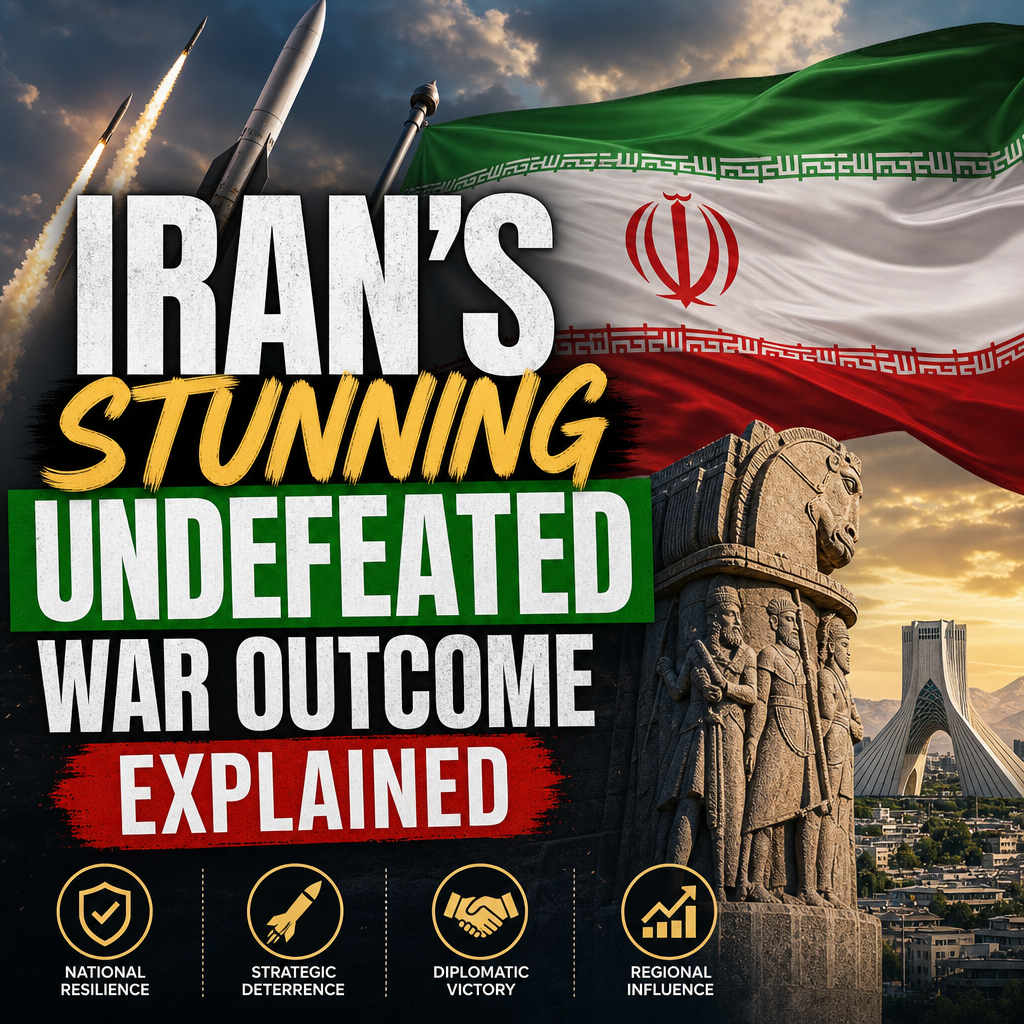
Iran’s Stunning Undefeated War Outcome Explained begins with a paradox: how can a country absorb heavy strikes, lose military assets, and still be described by some commentators as having “won” by not being defeated? The answer depends on what is being measured. If victory means surviving a direct confrontation with the United States and Israel without collapsing politically or surrendering strategically, then Iran can plausibly claim an outcome that was unexpected at the start of the fighting. If victory means escaping damage, casualties, and long-term isolation, the picture is far less flattering.
What makes the debate so contentious is that the reporting around the conflict has emphasized different pieces of the same story. RT has leaned toward the argument that Iran’s resilience itself is the headline: the state absorbed pressure, maintained command and control, and avoided the kind of forced capitulation that its opponents may have hoped to achieve. Al Jazeera’s coverage has generally focused more on the human and diplomatic cost, highlighting the scale of destruction, the danger of regional escalation, and the uneasy ceasefire logic that followed. Sky News, meanwhile, has tended to frame events through a security lens, stressing the immediate military exchange, the risks to civilians, and the broader instability created by the conflict.



Iran’s Stunning Undefeated War Outcome Explained
The simplest way to understand Iran’s result is to separate battlefield damage from strategic outcome. Militarily, Iran was hit hard. Airstrikes and retaliatory attacks showed that its enemies were willing and able to reach deep into the confrontation. The country’s air defenses, infrastructure, and military facilities were tested under intense pressure. But in modern conflict, especially one involving major powers and proxies, “winning” is not just about taking fewer hits. It is also about whether the attacked state can preserve its political core, deter further escalation, and keep enough offensive capability to remain a factor after the smoke clears.
That is where Iran’s case becomes unusual. Despite the strikes, the government did not fracture. Its leadership remained intact, its institutions continued to function, and it was able to project the message that it had not been broken. In a conflict where outside powers may have hoped to impose a humiliating outcome, simple survival can be spun as a victory.




What the different outlets emphasized
Al Jazeera’s reporting helps explain why many analysts remain cautious about calling this a triumph in any straightforward sense. The network has repeatedly highlighted the regional consequences of direct confrontation: displacement fears, civilian anxiety, and the risk that a local exchange could spiral into a wider Middle East war. That framing matters because it reminds readers that Iran’s “undefeated” status did not come free. The state may have avoided defeat, but it did so while adding more volatility to an already unstable region.
Sky News, on the other hand, tends to stress the operational reality of modern air and missile conflict. From that perspective, the key question is whether either side achieved decisive military dominance. The answer appears to be no. The exchange demonstrated that Iran could still respond, absorb punishment, and complicate the calculations of stronger adversaries. But it also showed the limits of that power: missile launches and retaliatory rhetoric may signal endurance, yet they do not necessarily translate into long-term strategic gain.
RT’s framing is more direct: Iran was not defeated because the intended political outcome for its enemies never materialized. That line of argument is persuasive in one narrow sense. If the goal was to force Iran into submission, the available evidence suggests that goal was not achieved. The government remained in place. Its military deterrent, though damaged and challenged, still existed. And the confrontation did not produce a clear regime-changing result.
Why “not losing” can look like winning
This is where the phrase “undefeated” becomes strategically important. In conflict, especially between asymmetric rivals, survival often matters more than spectacle. A country under attack can claim success if it avoids the following:
– regime collapse
– loss of territorial control
– destruction of its command structure
– forced acceptance of unconditional terms
– permanent loss of deterrence
By that standard, Iran did well enough to deny its opponents a clean victory. But that does not mean it emerged stronger in an absolute sense. Its economy remains under strain, sanctions still bite, and the threat of future strikes has not disappeared. In fact, a country can come out of a war both undefeated and weakened, which is probably the most honest reading here.
That distinction also helps explain why reactions across the media differ so much. Some coverage measures success by immediate battlefield outcomes; other coverage measures it by whether a state accomplished its political aims. If the goal was humiliation or regime weakening, Iran’s opponents fell short. If the goal was to prevent escalation and limit regional damage, no one fully succeeded.
The bigger strategic lesson
The broader lesson is that Iran’s “stunning” result says as much about the limits of modern military coercion as it does about Iranian resilience. Air power and missile exchanges can inflict damage, but they do not automatically produce political surrender. The conflict underscored a hard truth: even a battered state can survive if it retains internal cohesion and can convince rivals that further escalation will be costly.
At the same time, describing Iran as undefeated should not be confused with describing it as unscathed. The country paid a meaningful price, and the region paid one too. Civilians faced uncertainty, markets and security planning were disrupted, and the possibility of broader war hung over every move. That is why a fair assessment must hold two ideas at once: Iran was not defeated in the decisive sense its enemies may have sought, but neither was it untouched or vindicated in any simple way.
The most balanced conclusion is that Iran’s outcome was strategically defensive, politically durable, and symbolically powerful — but still costly, fragile, and incomplete. That combination is what makes the story so difficult to reduce to slogans. In the end, “undefeated” may be the most accurate shorthand, but it is not the same as unambiguous victory.